

Polish researchers have shown that photon‑counting CT improves lumen visualization where it matters most
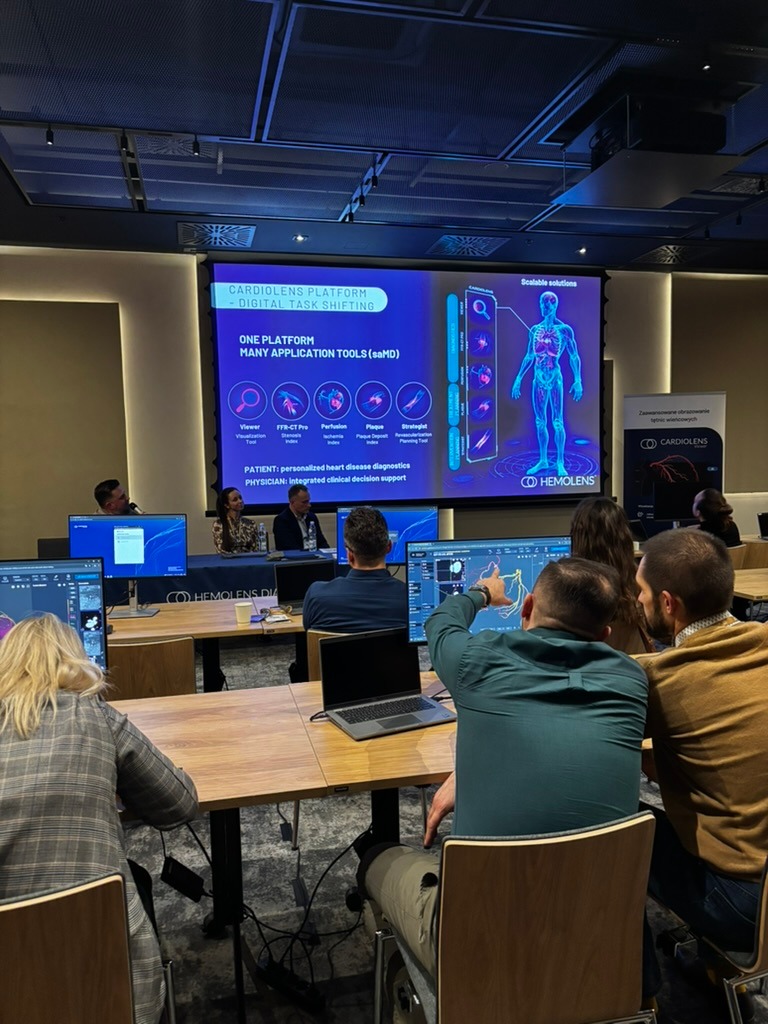
Polish teams brought photon‑counting CT into routine CCTA, with new data presented at EAPCI, backed by a special Congress Grant recognizing their work.
MUNICH, GERMANY, February 20, 2026 /EINPresswire.com/ -- Photon–counting detector CT (PCCT), previously highlighted in high‑profile RSNA and ESC presentations, is now firmly establishing itself in Poland and becoming part of everyday cardiac imaging practice. The first photon‑counting CT scanner was installed in October 2022 at the National Institute of Cardiology in Warsaw. Since then, additional centers have begun using PCCT for coronary CT angiography (CCTA). Polish research teams are also launching studies to test whether PCCT can improve the effectiveness and safety of CCTA in real‑world clinical practice. Early international data suggest that PCCT can provide ultra‑low‑dose CCTA with preserved image quality and more reliable stenosis assessment, particularly in heavily calcified coronary arteries [1].
The latest Polish contribution to this field has already attracted international attention. Results from a new photon‑counting CCTA study were presented by Prof. Mariusz Kruk and Jakub Kuć on 20 February during the EAPCI congress in Munich. The abstract was selected for poster presentation, and, in recognition of its scientific quality, the work also received a dedicated Congress Grant. This grant was awarded outside any formal application process, based solely on the scientific merit of the abstract and compliance with the formal criteria defined by the EAPCI organizers.
What makes photon‑counting CT different?
Conventional CT scanners rely on energy‑integrating detectors that sum the energy of incoming X‑ray photons. This limits spatial resolution and makes images more susceptible to blooming artifacts around dense calcifications. Photon‑counting detectors register individual photons and their energy. This enables higher spatial resolution, improved contrast‑to‑noise ratio, and routine access to spectral information from a single scan. For cardiac imaging, this can translate into clearer depiction of the coronary lumen, better visualization of stents and plaque, and the potential to reduce radiation dose without sacrificing diagnostic confidence.
In clinical practice, this difference is more than just physics. In patients with heavy coronary calcification, conventional CCTA often struggles with blooming artifacts that exaggerate the apparent severity of stenosis. This can lead to diagnostic uncertainty and, in some cases, unnecessary invasive testing. Photon‑counting CT aims to mitigate these artifacts, offering a more faithful representation of vessel lumen and plaque morphology. This is particularly relevant in ageing populations, where coronary calcium is common and non‑invasive imaging must balance accuracy with radiation safety.
International benchmark: from ultra‑low dose to better stenosis reading
Recent clinical studies show that PCCT allows ultra‑low‑dose CCTA protocols – for example, 70 kVp and high‑pitch helical acquisition – while maintaining diagnostic image quality and reliable stenosis grading [1]. Research presented at major congresses indicates that photon‑counting CT can reduce overestimation of coronary stenosis by limiting the impact of calcium‑related blooming on CT images [2, 4]. State‑of‑the‑art reviews now describe PCCT as a transformative technology in cardiac imaging, improving lumen assessment, plaque characterization, and myocardial tissue evaluation compared with conventional CT [3, 5].
These advances matter not only for academic centers but also for high‑volume hospitals that must combine throughput, safety, and diagnostic precision. By pairing ultra‑low‑dose strategies with improved image quality, photon‑counting CT creates a realistic path to standardizing CCTA protocols around one or two well‑defined series. This can simplify workflows, reduce variability between centers, and make it easier to integrate CCTA into national diagnostic pathways for coronary artery disease.
The current workflow of European radiologists in CCTA – including common bottlenecks and opportunities for protocol standardization – is described in detail in a freely available e‑book.
The Polish perspective
Early Polish pilot data come from a single‑center, retrospective observational study comparing photon‑counting CT with conventional energy‑integrating detector (EID) CT, both validated against intravascular ultrasound (IVUS). These data suggest that PCCT provides a less biased and more consistent assessment of the coronary lumen, especially in segments that are crucial for PCI and surgical planning. While detailed numerical results are not yet being disclosed, the trends point towards more precise stenosis grading in heavily calcified segments, where standard CT has traditionally been most challenged.
In Poland, a new research initiative is being set up to evaluate how photon‑counting CT performs in real‑world CCTA. The project will evaluate not only image quality but also radiation dose, workflow, and compatibility with advanced AI‑assisted tools such as the Cardiolens Viewer® and Cardiolens FFR‑CT Pro® (currently in development). It will focus on everyday patients in high‑volume cardiac centers rather than highly selected trial populations. The aim is to reflect the realities of busy cardiac imaging departments, where protocol simplicity, reproducibility, and seamless integration with existing infrastructure are just as important as peak image quality.
If Polish data confirm the early international results, photon‑counting CT combined with AI‑based analysis may soon become the new standard for non‑invasive coronary diagnostics – not only in university hospitals, but also in busy regional centers. For patients, this could mean more precise coronary imaging at lower radiation dose and fewer unnecessary invasive procedures. For clinicians, it could support more confident decision‑making in complex, calcified, or borderline lesions, with standardized image acquisition and advanced functional analysis.
In the longer term, embedding photon‑counting CT in routine CCTA pathways could help reshape how health systems think about non‑invasive coronary imaging. Instead of fragmented protocols and variable image quality, centers could move towards a streamlined approach built around high‑resolution, low‑dose acquisition and integrated AI tools. With their latest work recognized by an EAPCI poster selection and Congress Grant, Polish researchers are positioning themselves – and their patients – at the forefront of this transition.
References:
1. Nagy E, Maurovich‑Horvat P, et al. Ultra‑low‑dose coronary computed tomography angiography using photon‑counting detector computed tomography. Eur Heart J Cardiovasc Imaging. 2024.
2. Emrich T, Sartoretti T, Brunner F, et al. Ultrahigh‑spatial‑resolution photon‑counting detector CT improves assessment of coronary artery disease and reduces stenosis overestimation in calcified plaques. Radiology. 2024.
3. Flohr T, Mergen V, Allmendinger T, et al. Cardiac imaging with photon‑counting CT. Insights Imaging. 2023;14(1):148.
4. Emrich T, Si‑Mohamed S, et al. Coronary angiography with photon‑counting detector CT–new horizons for calcified plaque assessment. Br J Radiol. 2025;98(1175):1847.
5. Stolzmann P, Boussel L, et al. Photon‑counting detector CT: advances and clinical applications in cardiovascular imaging. Röfo. 2025.
Aleksandra Podkówka-Poźniak
Hemolens Diagnostics Sp. z o.o.
+48 505 162 174
aleksandra.podkowka-pozniak@hemolens.com
Legal Disclaimer:
EIN Presswire provides this news content "as is" without warranty of any kind. We do not accept any responsibility or liability for the accuracy, content, images, videos, licenses, completeness, legality, or reliability of the information contained in this article. If you have any complaints or copyright issues related to this article, kindly contact the author above.
